




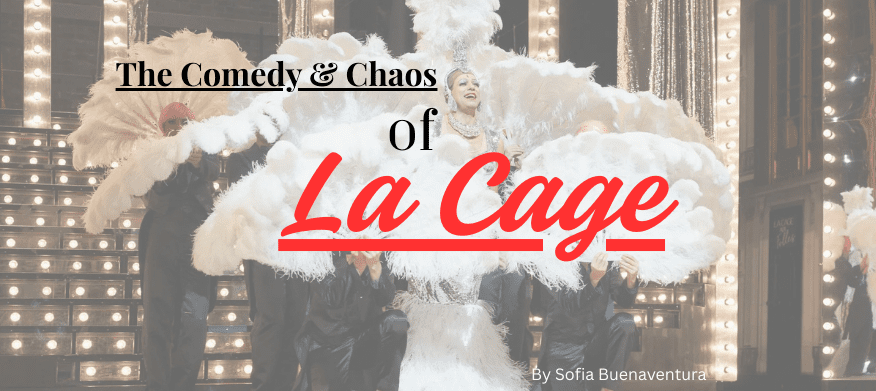
La Cage Aux Folles is a drag nightclub in St. Tropez, France, run by George, the master of ceremonies. His romantic partner, Albin, is a drag queen as well as the star performer of La Cage. The couple live an openly flamboyant lifestyle.
George’s son, Jean-Micheal arrives home with news that he is engaged to a young woman who just so happens to be the daughter of the head of the “Tradition, Family and Morality Party”, whose stated goal is to close the local drag clubs. With the girls’ parents desiring a formal introduction to their future in-laws, Jean Micheal begs his father to redecorate the apartment to a more subdued fashion. He also asks his father to keep Albin absent from the visit, and for his biological mother, who has barley seen him since his birth, to take his place.
Comedy and chaos ensue as the family is forced to hide their true colors and paint themselves as a family who gleam of tradition rather than one who sparkle in sequin.
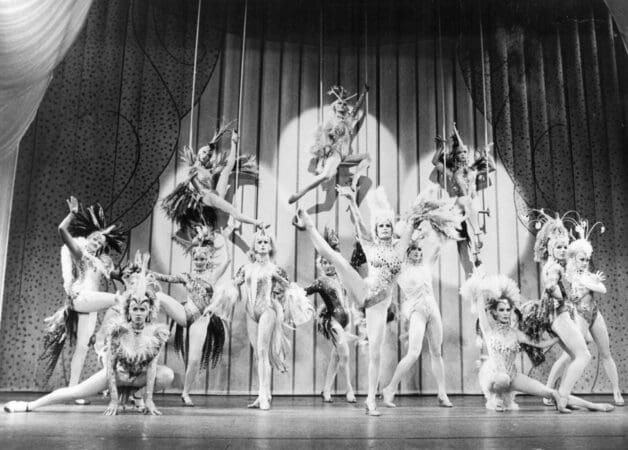
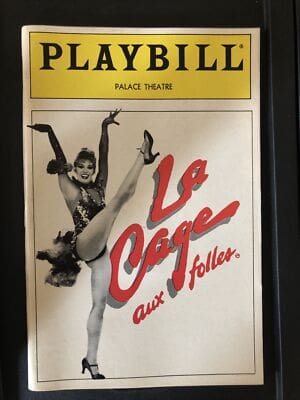
The original cast of La Cage on Broadway & the original playbill for the show. La Cage opened in the Palace Theater in 1983. The play has since been adapted to movies and is a classic production for theater performances around the globe.
George and Jean-Micheal re-decorate the house whilst Albin performs, and it isn’t until he begins changing for the next number when George breaks the news to him that they will be meeting with the future in-laws without his presence. Albin returns to the stage heartbroken, unable to hide the pain from being rejected by the people he loves the most simply for being who he is.
The first act ends with Albin singing the song I am what I am before storming off stage, a melodic statement to Jean-Micheal and George, as well to the audience, that regardless of how far he steers away from traditional masculine attributes, he is proud of who he is and refuses to change for anyone.
“It’s my world that I want to have a little pride in
My world, and it’s not a place I have to hide in
Life’s not worth a damn
‘Till you can say
“Hey world, I am what I am.”
“And so what, if I love each sparkle and each bangle?
Why not try to see things from a different angle?”
“’I Am What I Am’ became an anthem, not just for gay people but for lots of others, people in all sorts of programs that were being helped to give them some self-esteem and stand on their own.” said George Hearn, who originated the role of Albin in its original Broadway production. “It’s a wonderful piece, and the whole thing had a tremendous salutary effect on American culture.”
Based on a 1971 play of the same name, La Cage Aux Folles was performed for the first time on Broadways stage in 1983, August 21st.
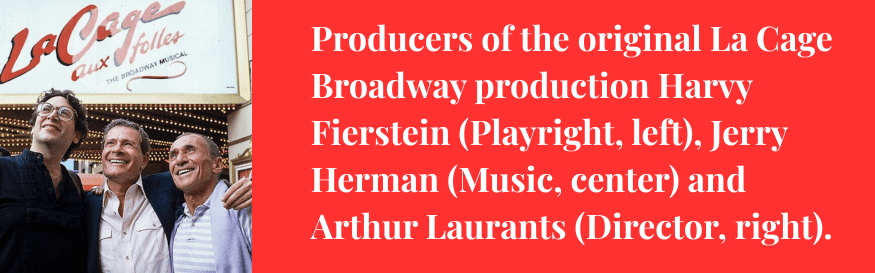
Written by Harvey Firestein, directed by Arthur Laurents, and composed by Jerry Herman, the original Broadway production ran for over four years with a total of 1,761 performances, winning 6 tony awards in 1984.
“It should always be playing.” Said George. “It’s an important piece, I think, and it did a lot of good things at a time when it was needed. There were many, many beautiful stories that came out of it. It opened up life for a lot of people.”
La Cage was adapted for film (1979) and became an inspiration for other movies, including The Birdcage starring Robin Williams and Nathan Lane (1996). Film critics agree both films – like the Broadway production – still stand the test of time.
Being the first musical to openly discuss homosexuality, La Cage had an immense impact on not just the Broadway world, but on society itself.
“I had a Republican, right-wing, brother-in-law who was a little homophobic but a loyal fan and a terrific guy. He and his wife came up from Orlando to see it. And he said, ‘Good job, that was nice. That took a lot of nerve and you did it really well. We enjoyed it.’ So six months passed, and my sister Anne said, ‘Six months and he didn’t even mention it!’ And then at breakfast one morning, he said ‘You know, Anne, if those two guys really loved each other-I guess it’s none of my business.’…Now, you can’t legislate that. You can’t get a preacher to do that, you can’t make that happen. But the theater can have that kind of power, that it touches people in a way, that it can inflect them a little toward another point of view.” -George Hearn.
“I know that La Cage changed people’s perceptions about gays because I was in those theaters all over the country and I saw people come in very skeptical and I have a specific story to tell you.” Said Jerry Herman, composer of La Cage.“… about 15 or 20 minutes into the play, the lights of Saint-Tropez came on a little cafe table came on, and Georges sang a love song to Alban. This was the first time in the history of musical theater that a man sang a love song to another man, and we were sitting frozen in our seats, wondering what the audience was going to do. And right in front of us, there was a typical Bostonian couple … it’s a song about remembering a first lovely experience with someone walking on a beach … It’s about love … when it got to the line, ‘I’m young and in love’, this man took his wife’s hand and squeezed it, and the three of us started to cry. Sound at all, we were bawling in the back of the theater, because we knew that this show would reach a mass audience and that it was not an esoteric show about gays, that it was about love and family. And we were right, because it went on to play everywhere in the world, but that was the night we knew what we had.”
It is about them being who they are, and who they are needs no excuses.