



While teachers and school leaders are questioning their ability to adapt to the reality that AI is here to stay in the classroom, employees of school districts across the country are really struggling to figure out why. It’s easy to assume that AI-using students are lazy, lack confidence in their work, or simply don’t care, but research doesn’t back this up. Hard to believe this fact: 80 percent of students use artificial intelligence in the classroom, but few are using it to cheat.

Take an example of how AI is really being used in school, according to studies by the College Board, Stanford University, and the Chronical of Higher Education. Many students are struggling to finish essays on time, so they use AI to brainstorm ideas, edit, or revise their own work; not to replace it. Most students use ChatGPT, Gemini or other AI services to conduct research or get a quick rundown of reference information, like a dictionary or a textbook might provide. Like other revolutionary inventions (the Internet and cell phones among them), teachers now face a new challenge; putting guardrails up to limit the 20 percent of students who use AI to imitate (or replace) their own work.
80% of Students Use AI. 20% Use It To Cheat.
Ask any teacher about how AI has suddenly entered the classroom and you’re likely to hear fear, confusion, and/or anger over students using it. Of course, companies such as Instructure (the inventor of Canvas) have implemented artificial intelligence checkers in their student submissions area. Things like this have prevented students from using artificial intelligence to gain an unfair advantage in class. With the rise of artificial intelligence in classrooms, one study shows that between the 2022 and 2023 school year, only 48 percent of students were given disciplinary actions for using AI, while in the 2024-2025 school year, it rose to 64 percent.
Teachers Don’t Show Students How To Use AI; They Just Tell Them Not To.
 However, with all the tools in place to detect artificial intelligence in schoolwork, only a few use it to learn. A staggering statistic shows that only one in 12 children use artificial intelligence to learn, meaning the other 11 are using artificial intelligence to cheat. It’s a fact that using artificial intelligence to cheat on assignments will affect people in the long term with worsening abilities to read, write, and do math. Sadly, with the rise of artificial intelligence in the cheating scene, teachers are not teaching children to use AI properly and are only telling them not to use it.
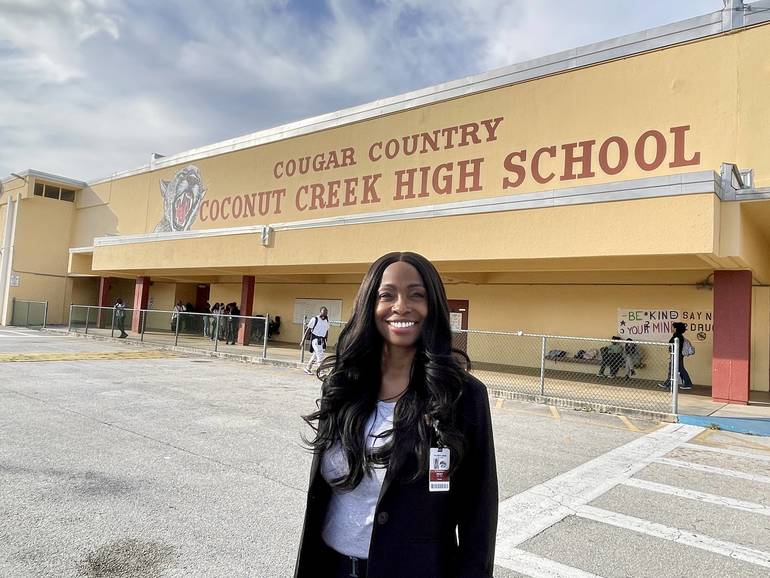
Taking The Lead In AI: Broward Schools and Microsoft.
 With one in 12 students using AI to learn in class, there is still hope as one of the biggest school districts in the USA has started to invest into AI technologies so students can learn how to use AI properly: Our own. Broward county has started partnering with Microsoft in hopes of teaching students how to use artificial intelligence properly by using it as their study parter, in addition to their teachers.
Artificial Intelligence has the potential to revolutionize teaching in many ways; children could even get careers in the industry of artificial intelligence, which is a huge industry.
Scholar Jace Lathan says, “Students should be using AI in class so it can help improve their grades and academics, but it also brings students together as they learn. AI helps.”
But how can Broward successfully move on from prohibiting AI usage in class to successfully bring it into schools? Mr. Yeargin says, “I think because of what’s going on around the country and around they world, AI is one of the driving points in technology now. So, I think Broward schools needs to push that initiative forward.”
The clear goal here for Broward is to not remove AI in the classroom, but to actually introduce it as a learning application.